
Nobody Will Know You're There
Remembering Bud Cort, 1948-2026

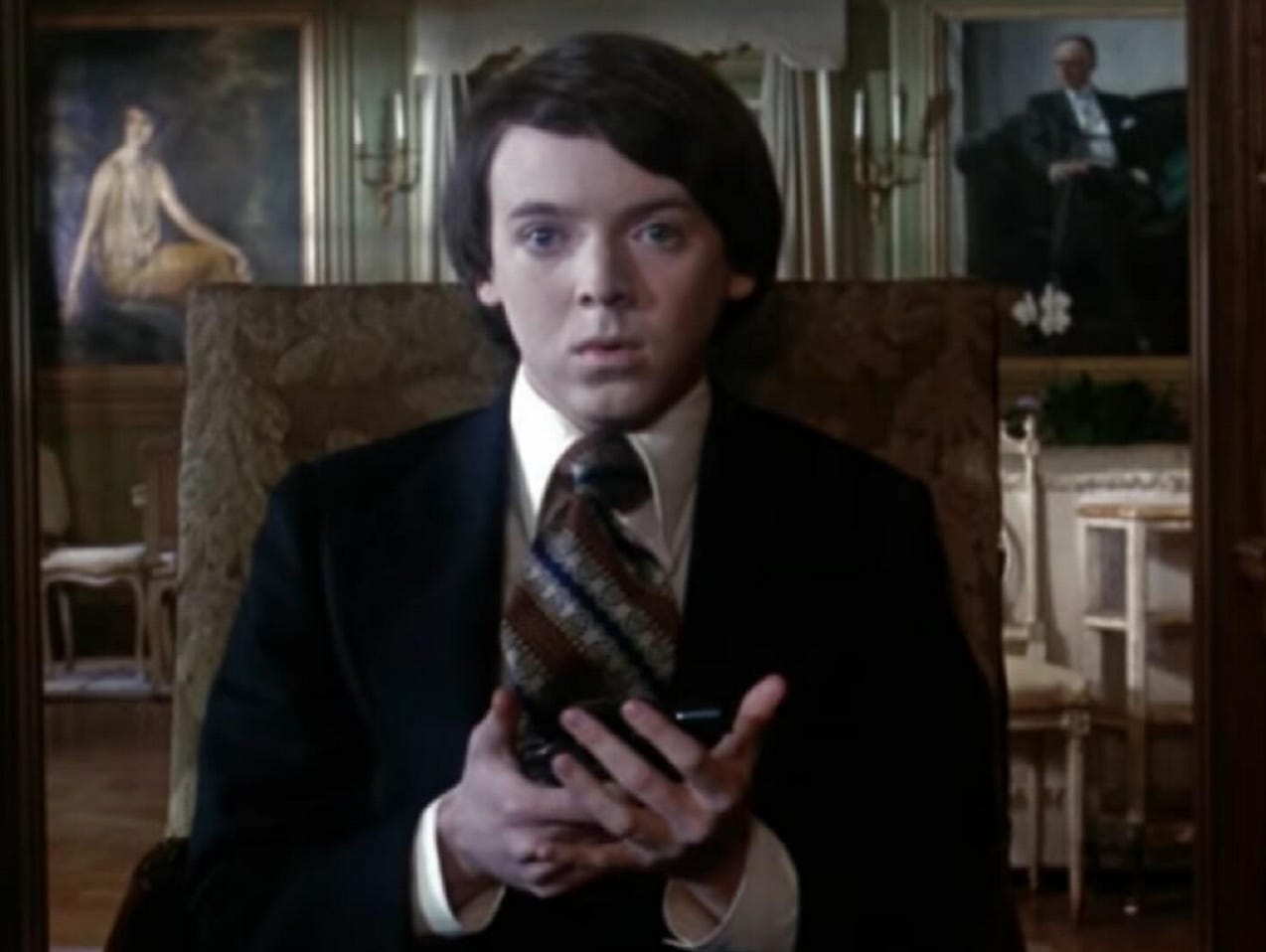
Another post from the archives! This is a passage from White Flights: Race, Fiction, and the American Imagination about my favorite movie of all time, Harold and Maude. Bud Cort, who was best known for playing Harold (though he has many other excellent acting credits) died yesterday at age 77.
I saw Harold and Maude for the first time at summer camp, in the summer of 1988, when I was thirteen. It was, unapologetically, nerd camp: the Center for Talented Youth, on the campus of Scripps College, a Mission-style villa in the mountains outside Los Angeles, with fountains, lots of wrought iron, improbably green lawns, cool, echoing tiled rooms. All these details matter in some way. My camp friends were the artsy ones, with goth or punk affiliations; Shoshana, Rachel, Sean, Gabby. They were all two or three years older, sneaked cigarettes, quoted Wilde, and dispensed all kinds of worldly knowledge; they said this movie, above all others, would change my life.
In the first scene—filmed in such low light that at first it’s difficult to distinguish one object from another—a young man in a three-piece suit, filmed almost entirely from the shoulders down, moves around a richly appointed Mission-style room, lighting candles and incense, putting a record on the hi-fi (Cat Stevens, “Don’t Be Shy”), writing a note on a side table, pinning it to his lapel, finally climbing onto a chair and kicking it away, leaving his shoes swinging in midair.
This is a faked suicide: a moment later, and then over and over in the first third of the movie, his face appears in the pose of pretend death. Harold Chasen is a fatherless only child of an obscenely wealthy family; he’s dropped out of prep school and lives with his mother in a mansion near Big Sur. All this takes place in 1971. To draw attention to himself, to pass the time, to channel his otherwise unfocused rage and despair, he stages his own death. In one of these scenes, he imitates a Vietnamese monk’s self-immolation, using a dummy and a disappearing trick; when he reappears, unharmed, and fully dressed, in front of his mother’s fury, he looks at the camera and smiles.
He knows the viewers are with him. Who is he? An absurdly large puffy Windsor knot that only makes him look more childlike, a boy in a man’s suit, with a boy’s overgrown bowl haircut and slight dimples. He’s acting. Everything in his life is a performance, between quotation marks, “as if.” Except for one ambiguous feature: his face is extremely white, several tones lighter than his mother’s skin. One word for it would be pallid. Deathly, or proto-Goth.
Is Harold’s extreme whiteness part of his performance, or is it the condition of his life? The goths I knew as a teenager—those who used that term and those who embraced the symbolism without it—used makeup but also stayed out of the sun, using their bodies as little as possible. I think they knew that belonging to a subculture was a way of making wishful thinking look permanent, as if their hearts really were on their sleeves. To be goth, to wear death drag, is a way of making ordinary life look unbearably dull and cloying and lamely theatrical by comparison. Reverend Moody, in Hawthorne’s “The Minister’s Black Veil,” was in some ways the first goth; on his deathbed he accused everyone in the town of secretly wearing the same black veil.
In her review of Harold and Maude, Pauline Kael found the Cat Stevens lyrics that fill nearly every interstice in the movie unforgivable; she called them “mush-minded.” Out of context, they might be; as part of the movie, they create the tension between performance and feeling that feels unbearable and is meant to be unbearable:
Don’t be shy—just let your feelings roll on by
Don’t wear fear—or nobody will know you’re there
Only when Harold, the performance artist with an audience of one—the way all adolescent artists-to-be grasp the nightmare that their parents may be their only audience—meets an actual artist, Maude, who calls him on his pretensions, does his façade break down, and he begins to grasp the dimensions of his actual sadness. Then, with Maude’s help, he begins to make art again.
This is a radical simplification of the movie—leaving out for the moment the part about Harold and Maude’s love affair, her age, her background—but it’s true to what I saw, at age thirteen, in surroundings very much like the film I was watching: I saw a movie that was trying to teach me, personally, how to live. That was what was so electrifying about it.
I lacked a language for explaining Harold’s transformation until I read Peter Sloterdijk’s Critique of Cynical Reason, which dwells at great length on the difference between cynicism and what he calls “kynicism.” Cynicism, in the sense the term is used today, is what Sloterdijk calls a form of coping, of “enlightened false consciousness”:
Psychologically, present-day cynics can be understood as borderline melancholics, who can keep their symptoms of depression under control and can remain more or less able to work. Indeed, this is the essential point in modern cynicism: the ability of its bearers to work—in spite of anything that might happen, and especially, after anything that might happen . . . . For cynics are not dumb, and every now and then they see the nothingness to which everything leads. Their psychic apparatus has become elastic enough to incorporate as a survival factor a permanent doubt about their own activities. They know what they are doing, but they do it because, in the short run, the force of circumstances and the instinct for self-preservation are speaking the same language, and they are telling them that it has to be so. . . . Cynicism is that modernized, unhappy consciousness on which enlightenment has labored both successfully and in vain. Well-off and miserable at the same time, this consciousness no longer feels affected by any critique of ideology; its falseness is already reflexively buffered.
Kynicism is an older, stranger, and far more radical way of life: it begins with Diogenes of Sinope, who lived in a dry cistern near the marketplace in Athens and identified himself with dogs; “kynic” is derived from kynikos, “dog-like.” “Other dogs,” Diogenes said, “bite their enemies. I bite my friends to wake them up.” He called himself cosmopolites, “a citizen of the world,” and carried a lantern through the marketplace at midday, saying he was searching for an honest man. Once, Alexander the Great came to visit Diogenes while he was lying in the sun, perhaps getting a tan. “Get out of here,” Diogenes said, “you’re blocking my light.” When invited to a wealthy man’s house and cautioned not to spit anywhere—the kynics were famous for relieving themselves wherever and whenever—he spat in the owner’s face, saying, “I can find no more appropriate receptacle.”[1]
Maude, a Holocaust survivor who lives in an abandoned railroad car, steals cars and defaces statues for fun, and practices every art form she can manage, is a quintessential kynic; Harold, a cynic to the core, is appalled and frightened by her. “I don’t know if that’s right,” he says peevishly, when she explains her philosophy of car theft. But slowly, indefatigably, Maude breaks down his defenses; the movie is entirely on her side. Diogenes, Sloterdijk writes, “could be taken as the original father of self help . . . . he was a self helper by distancing himself from and being ironic about needs for whose satisfaction most people pay with their freedom.” Harold and Maude’s version of self-help partly involves turning his talent for pranks-as-performance-art on authority figures other than his mother, including his uncle, a high-ranking army officer, and a police officer who tries to arrest them, in what is possibly the funniest chase scene in film history.
But Harold and Maude’s most radical self help lies elsewhere. Cynics, by definition, are unable to cry; Harold desperately needs to. Once he’s had sex with Maude, and smoked a hookah, he can: his face screws up, becomes ugly, disfigured, ordinary, as he weeps, telling Maude the story he inevitably has to tell, of feeling isolated after his father’s death, estranged from his mother, her pretensions and insecurities.
The ordinariness of this moment—how embarrassing it is, how hard to watch—deserves close attention. The entire film has led up to this experience of catharsis, which could have happened in any therapist’s office, or in the arms of any lover, or friend; but Harold is so traumatized, so isolated, such an “advanced case,” that it takes extreme measures to lead him out. And the extreme measures are just beginning: shortly after this scene, Maude announces she’s taken an overdose on the night of her eightieth birthday. After she dies, Harold drives his car off Big Sur, but jumps out at the last moment, and strolls away across the bluff, playing a banjo Maude has given him.
Where does he go? This is an unfair but necessary question. The end of Harold and Maude holds cynicism and kynicism in a perfect balance. It’s Harold’s greatest and (presumably) final performance, the last trick he will ever play on us, but also, of course, much more than a trick: this time the grief and the anguish, is real. In Freudian terms, he may have broken through the cycle of melancholy and finally become able to mourn—depending on what he does next. What kind of artist will he be, and where will he go? What song will he sing?
If the problem of closed endings is one of false necessity—bringing the narrative back to the limitations of the so-called real world—the problem of open endings, in late capitalist culture, is that they are always subject to cynical recirculation: they can always become objectless gestures, “meaning” nothing but themselves. In 1998 Wes Anderson made an objectless, sanitized version of Harold and Maude called Rushmore, where Harold is Max Fisher (played by Jason Schwartzmann), a scholarship student given to bizarre, theatrical antics—as well as actual theater—at his prep school, and Maude is Rosemary (played by Olivia Williams), a beautiful thirtysomething elementary school teacher. In this setting, the love affair never actually happens, and neither does the attempted suicide; Max Fisher’s face never addresses the screen, and never breaks down into abysmal, ugly, ordinary grief. The surface and the pretense are perfectly consistent.
This is not to say that Anderson’s characters—now duplicated, with slight variations, in the many movies he’s made since, including The Royal Tenenbaums, The Life Aquatic With Steve Zissou, The Darjeeling Express—have no emotions at all. They do. Their emotions are perfectly proportional to the closed, hermetic, purposely artificial worlds they inhabit; their strongest feelings come at moments when those worlds are threatened. They tend to be immensely wealthy, extremely fragile, highly naïve, and very, very pale.
In an American context I don’t think the question of cynicism can ever be unbound from the fact of white supremacy. Anderson’s career demonstrates this, maybe better than any other artist of his generation in any field. Using Bill Murray’s decaying face, he’s created an index of white melancholy, both bland and inert, detached, literally self-effacing. Not surprisingly, he’s stuck there: in a cycle of productivity that is itself a performance, the way Harold, in his mother’s house, was always looking for another variation, a new entertainment, as an alternative to actually dying.
[1] I’ve taken the title of this essay from an episode in the ongoing struggle (as Sloterdijk describes it) between kynicism and cynicism. The Roman writer and cynic Lucian once described the death of Peregrinus, a kynic and convert to Christianity, who self-immolated at the Olympic Games in 185 CE. “If . . . he is so firmly determined to die,” Lucian wrote, “why does it have to be by fire and with a pomp fit for a tragedy? What is the point of this way of dying when he could have chosen a thousand other ways?”