

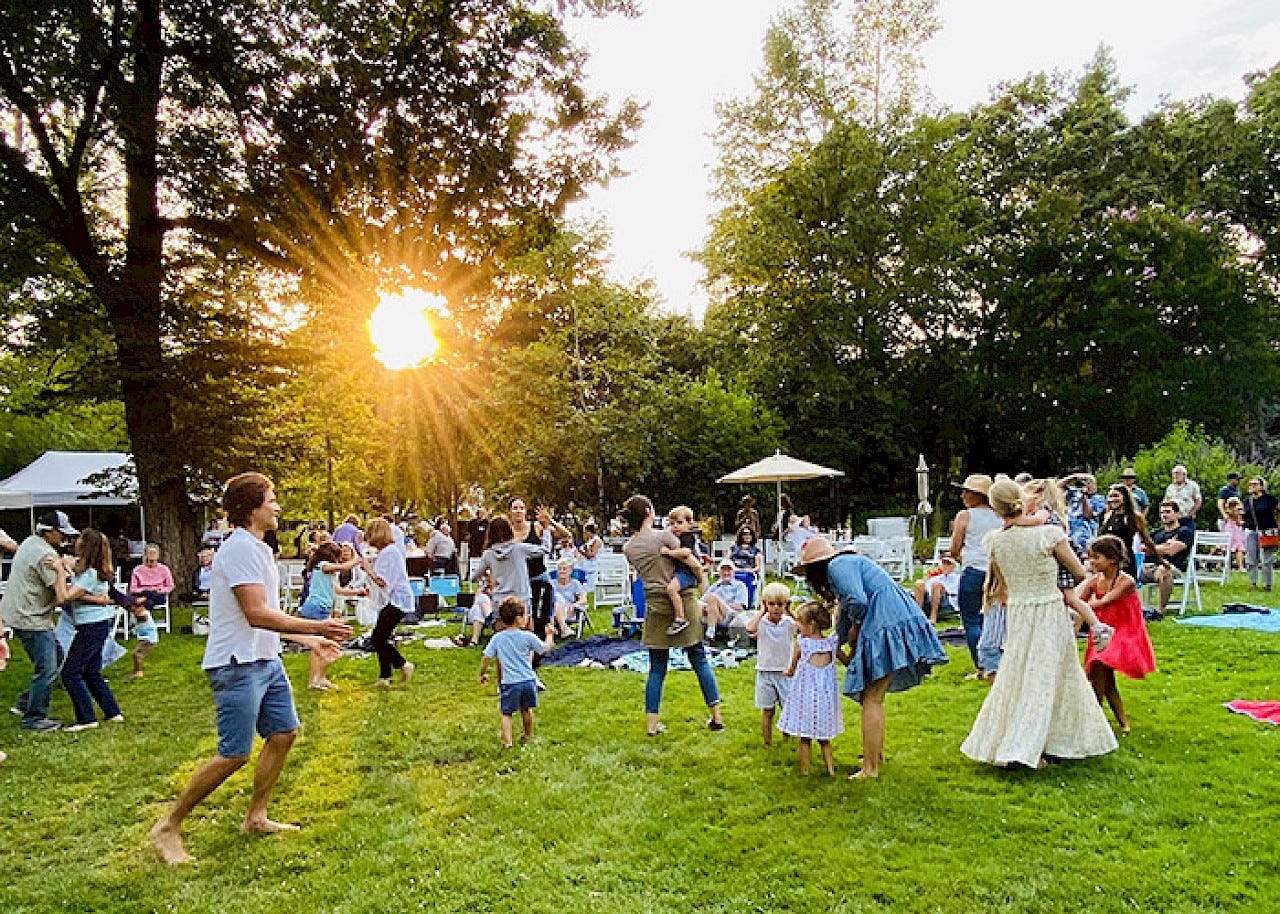
Note: I have a new book coming out! Storyknife is my first collection of short stories in 15 years, a collection of metafictions, experiments, and good old-fashioned tales about white liberal America teetering on the brink of (and then going over the brink of ) disaster. It’ll be released by Ecco in July 2026. Over the next year I will be highlighting each story in the collection in a brief post, starting with the most August of all August stories, “Summer Song.” It was originally published by Tin House in 2012 and isn’t available online, but I’ll include plenty of excerpts below.
As a hopeless lover of all aspects of summer—backyard parties, swimming holes, outdoor concerts, lobster shacks, sangria, gazpacho (I make really good gazpacho)—I was always destined to writing something like “Summer Song.” I even had the title in mind: it comes from the chorus of Buffalo Tom’s “Summer,” which I had on constant rotation in 1995, when I was an Outward Bound instructor on an island in Boston Harbor: Summer's gone, a summer song / You've wasted every day / Summer's gone, can't wipe it off my hands / Write it in the sand—
But it wasn’t until about 2010 that I came up with the idea of making a summer story a kind of incantation, told in the third person plural. Here’s how it starts:
Perched on the edges of lawn chairs, on barstools, on damp and moldy-smelling picnic blankets, on park benches, in the spreading branches of oaks, maples, copper beeches, they watched World Cup games, Wimbledon matches, jazz sets, Yasojiru Ozu marathons, and hundreds of performances of the 1812 Overture, with cannon and fireworks, or without; they watched flag-football and street hockey, bocce and badminton, ultimate frisbee and frisbee golf, lacrosse practice and swimming practice, roller derby and tai chi. Much of what they did that summer involved watching. With the windows open, and the ratcheting of the katydids, or with the windows closed, in the low hum of the central air, they watched cable news, broadcast news, televised movies, streaming movies, YouTube hits, home movies, 16mm experimental films from Dad’s days at USC in the Seventies. They watched Shrek and Bride of Frankenstein, Deliverance, The Breakfast Club, Bring Me The Head of Alfredo Garcia, The Killing of a Chinese Bookie. There was a special relief in the darkness, after so many hours of retina-splitting daylight, in the blue glow of LCD or plasma screens, and many remarks were heard, particularly from watchers over sixty, about how much larger TVs have gotten, how immense, how gargantuan, how lifelike, how they occupy an entire wall of the living room now; and a few remembered that in Farenheit 451 every house had been equipped with wall-size television screens that played incessantly, at screeching volume, how the fugitive had been pursued by TV helicopters and watched, on TV, by those whose houses he was passing by. A few wondered if Ray Bradbury was still alive, and one or two said, “Totally, I read an interview with him in the Paris Review.”
Who is the “they” in “Summer Song”? Originally I chose the epigraph of the story from the Communist Manifesto as a joke: “The bourgeoisie naturally conceives the world in which it is supreme to be the best.” I was preparing to read the story at the Vermont College of Fine Arts’ summer MFA residency (where I was faculty at the time) and one of my students remarked that instead of reading their own work they felt they should get onstage and read Marx. But the epigraph isn’t really a joke at all; it was more or less the guiding truth of my upbringing. 2010, when I wrote this story, was the era of the Great Recession and Occupy Wall Street; I had just recently spent a summer camping trip—yes, there’s summer again—swatting mosquitoes and reading Chantal Mouffe and Ernesto Laclau’s Hegemony and Socialist Strategy, one of the classics of modern Marxist thought. “Summer Song” is very much a meditation on hegemony, that is, about how elites naturalize themselves and their way of life—in this case, the predominantly white liberal East Coast bourgeoisie I was born into and am still adjacent to:
They visited. They vacationed. Too often the one passed for the other, the obligation imagined as voluntary, the responsibility made recreational, vacation days, sick days, contractual days, all poured into the well of compromise plans, meetings in between, discount hotels three blocks from the beach, borrowed houses in Wellfleet where the toilet overflowed and raccoons shuffled all night through the attic. Nonetheless, they swam, kayaked, sailed, hiked, ballooned, snorkeled, biked, hosteled, marathon-trained, spelunked, water-skied, fly-fished. They lay awake on strange sheets—who buys satin sheets anymore, and who would keep them in a summer house on a lake in Maine, for god’s sake?—and listened to frogs harrumphing across the pond. They stumbled filmy-eyed down strange hallways and mistook closets for bathrooms, the kid’s room for Uncle Tom’s room. They had awkward reunions with siblings, parents, aunts, great-aunts, people they hadn’t seen in fifteen years and hadn’t wanted ever to see again, at anniversary cruises, cousins’ bat mitzvahs, yacht club and country club and Rhinebeck lawn and North Jersey Indian weddings.
The moment when I was writing “Summer Song” was the moment I was realizing the values of that class were no longer my values; as Jedidiah Purdy (who is exactly my age and had a similar upbringing) puts it, I had become an accidental neoliberal. I was realizing Democratic politics had become a smokescreen for the rise of a new corporate oligarchy that not only controlled the party and its politicians but had convinced the rest of us that, as Frederic Jameson (and later Mark Fisher) put it, “It’s harder to imagine the end of the world than the end of capitalism.” The passionate incrementalists, policy wonks, and inveterate pragmatists I was surrounded with growing up are exactly the kind of people Jameson had in mind; in that world, the correct path led from prep school to the Ivy League to graduate school (law, public policy, economics, journalism) to a job on Capitol Hill, a think tank, a federal agency, a “good cause nonprofit,” or the Washington Post. You were supposed not to participate in the world’s problems but study them, often from the vantage of a beach chair in Rehoboth Beach, Nantucket, Jacob’s Pillow, Truro, Booth Bay, Vinalhaven—the places I’ve tried to evoke in “Summer Song.” When I was writing Your Face in Mine, the phrase I came up with to describe this life of this particular class of people was “white dreamtime,” which perfectly describes “Summer Song” as well:
There were moments when they worried about the inchoate, almost unmentionable things you can’t talk about at parties, like the problem of evil in light of God’s omniscience, or the potential for decades-long economic depression following a global credit collapse, the futility of recycling, the country’s general embrace of fascism. Was it OK to hang Fourth of July bunting from your porch in order to promote the town economy, the revitalization of Main Street, the success of Wallaby’s Organic Market, where red white and blue vegan cookies were on sale at $10.99 a pound?
The thing about summer is that it’s a time people live most vigorously inside their dreams and fantasies, and to the extent “Summer Song” is pretty bleak satire (especially considering how badly the world has fared since the early 2010s) I am very much one of its targets. Last year I wrote about the spectacular misadventure my family has had with our second home in Vermont, which is threatened by the rise of catastrophic flooding in the Northeast (and around the world, of course). That is my personal talisman for how the values and fantasies I was raised with no longer apply to the world as it is today.
But what comes next? This is when I start to feel extremely old. My memories, my associations and resonances, stretch back to the late 1970s. I can remember Reagan’s election in 1980. Which means I’ve been witnessing the slow decline of the white liberal professional class my entire life. Sometimes I feel (in the way probably a lot of American writers today feel) like a German author in the mid-1930s, looking forward into the abyss but also looking backward into our own rich and plangent memories of a world about to go extinct. The whole point of Storyknife is that a story can turn into a knot that chokes us but also be the blade that cuts through it. Maybe in the case of “Summer Song” the story is the knot and the epigraph is the knife—because as Marx knew very well, elites keep assuring themselves that everything is fine until the moment the lights go out. Those lights are flickering right now.